
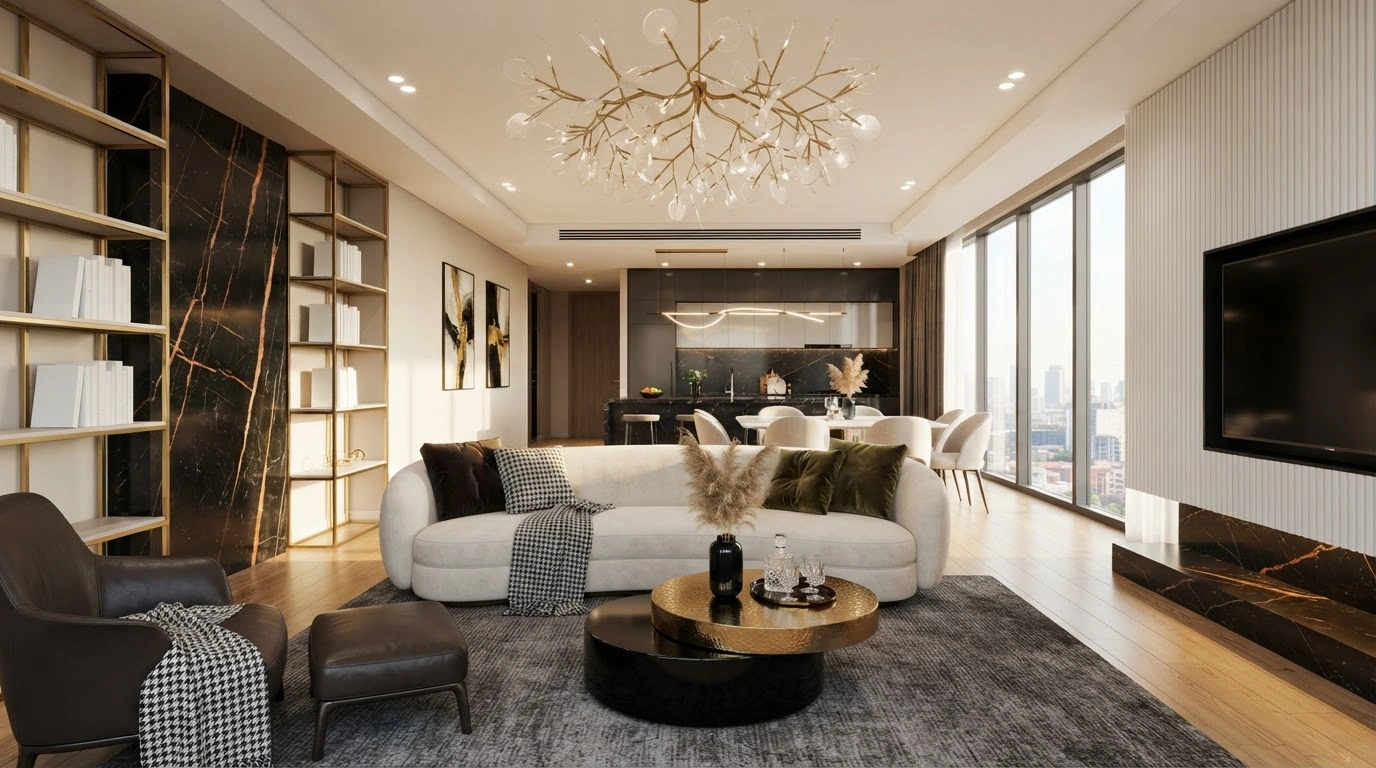
You've seen the room. Maybe it was a photo you saved months ago, or a bedroom in a magazine, or a hotel lobby you couldn't stop looking at. You copied the sofa, the paint, the lamp, and when it was all in your own place, it looked fine. It just didn't feel like the picture.
That gap isn't a failure of taste. It comes down to what a photograph can show and what it can't, and once you know where the difference lives, you can use pictures much more intelligently.
What a Camera Quietly Does to a Room
Interior photographers are good at their job, and part of that job is making a space look its best. Several things happen before you ever see the image.
The lens is usually wide, which stretches a room and makes it look bigger and deeper than it feels when you walk in. The lighting has been chosen, and often added, so that every surface glows and nothing is in shadow.
The space has been cleared of everything that makes a home look lived in: cords, mail, laundry, the stuff on the fridge. And it was shot at one moment, at the flattering hour, with the curtains arranged just so.
None of that is dishonest. But it means the picture is a highlight reel, and you're comparing it with a room you live in on a wet Tuesday.
The Things Photos Can't Carry
A picture is purely visual, and rooms aren't. That’s one of the reasons why you may feel such a disconnect when you try to replicate that vibe in your own space.
Scale and proportion: A photo flattens depth, so a sofa that's the right size for a large room can look perfect in a picture and swallow a smaller one. A chair that looks delicate on screen might be much bigger in person than you expect.
Ceiling height: This one's worth a pause. Research published in the Journal of Consumer Research found that a noticeably high ceiling tends to prompt a feeling of freedom, while a low one prompts a sense of confinement, and that this shifted how people processed information. That's a controlled study, not a verdict on your living room, but it points at something real. The proportions of a space act on you, not just on your eyes, and a flat image can't make you stand under them.
Sound and temperature: A beautiful room full of hard surfaces can echo, and a photo won't tell you. The same goes for a cold floor, a draught or a stuffy corner. Both weigh heavily on the feeling you get from your living spaces, and well-designed spaces account for both of them to evoke a sense of calm and wellness.
Light over the day: A photo captures a single moment. A room that glows at noon can feel gloomy at five, and the reverse is just as common. Interior design specialists pay particular attention to natural light, because that has a direct impact on how you feel in the spaces you spend most of your time in.
Texture: Materials that look rich on a screen can feel thin, or scratchy, or cold. You only find out by touching them. Some materials may not necessarily work in your town, perhaps due to weather patterns such as heat and humidity. Those factors must be accounted for when selecting the materials to furnish your spaces with.
How to Read a Photo Without Being Fooled by It
None of this means you should stop looking at pictures that inspire you to elevate your living spaces. It just means looking at them differently.
Ask what you're actually responding to. When you save an image, try to name the one thing that caught you. Maybe it’s the way the light fell, the colour of the wall, the lack of clutter, the warm wood against something pale.
A folder of interior design inspiration is only useful if you can find the pattern in it, and the pattern is almost never the lamp. It's usually a feeling, like calm, warmth or openness, and a feeling can be recreated in a room that looks nothing like the photo.
Then look for the part the photo can't tell you. How big is it really? What's the ceiling like? Where does the daylight come from, and what's it like in the evening?
Test It in Your Own Space Before You Commit
A few cheap checks stop most disappointments, so it’s very important to take your time and be mindful about what you’re committing to.
- Mark the size: Tape the footprint of a sofa, rug or table on the floor, or use flattened cardboard boxes. Live with it for a day and walk around it.
- Check the light at different times: Look at the wall and the corner you're planning to change in the morning, afternoon and evening. Paint and fabric samples should be seen in all three, not under a shop's lights.
- Handle the materials: If you can, touch the fabric, sit in the chair, feel the finish. Samples are often free or cheap.
- Listen to the room: Clap once. If it rings or echoes, the room needs something soft, like a rug, curtains or upholstery, before it needs anything decorative.
- Take a photo of your own room: It's surprisingly useful. If your room looks good in a photo but feels wrong, or the reverse, you've learned something about what you value.
Go and Stand in Rooms You Like
If you want to get better at this, spend more time in real rooms. A friend's living room that always feels calm. A café you keep going back to. A hotel lobby with good lighting.
Pay attention to why you feel at ease there. How high the ceiling is, how far apart the seats are, how the light falls, how much noise there is. You'll pick up more from standing in one good room for twenty minutes than from scrolling a hundred pictures.
The Point of the Picture
Photos are good at starting an idea. They're much worse at finishing it. Treat what you save as a question about what you want your home to feel like, and then answer it in the room itself, with a tape measure, a sample pot and a few days of paying attention.
That's how a room ends up looking good and feeling right once the photographer has left.