
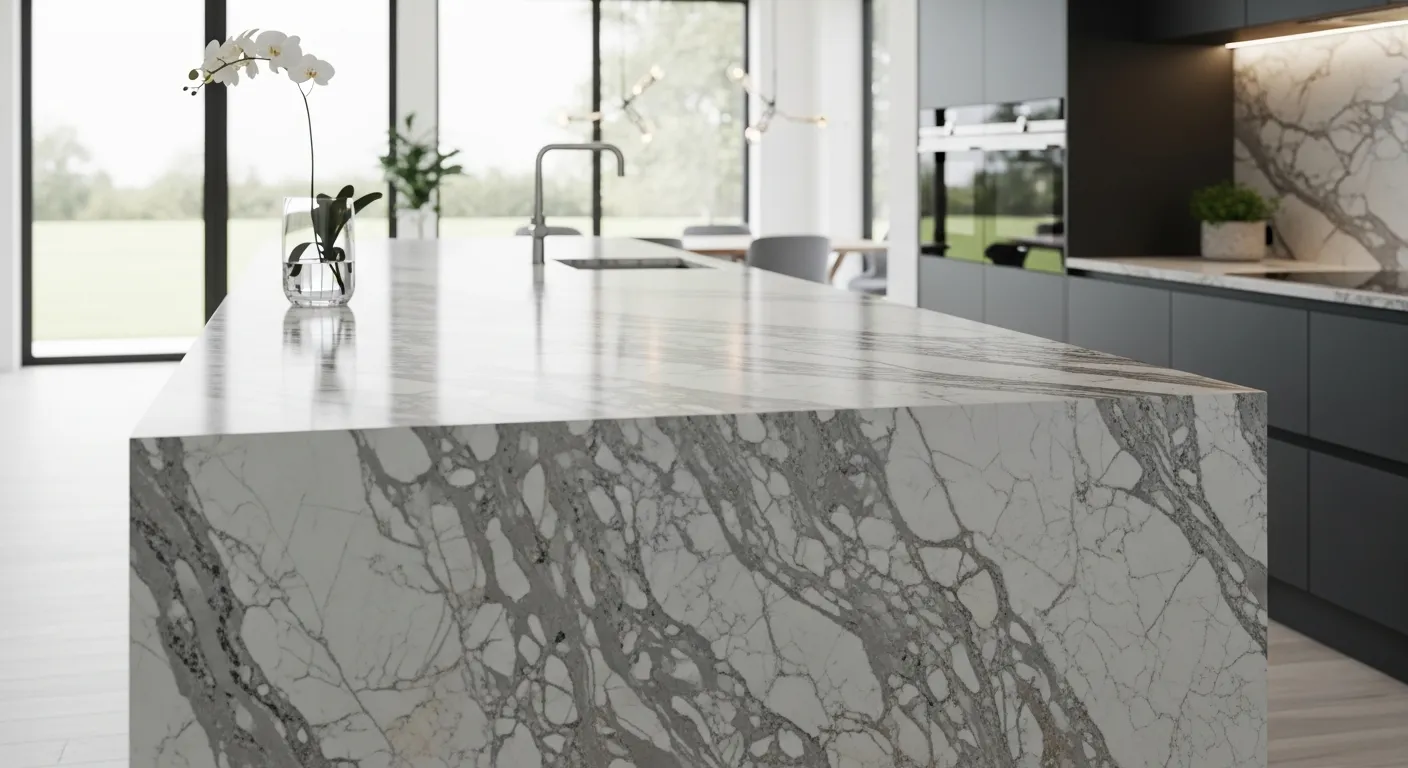
Few materials manage to be both beautiful and indestructible, but quartzite makes a convincing case. Born when quartz-rich sandstone is reshaped by extreme heat and tectonic pressure, this metamorphic stone carries the soft, painterly elegance of marble with a hardness that outperforms granite. For homeowners and designers who refuse to choose between aesthetics and durability, it has quietly become the surface of the moment.
A Stone Forged Under Pressure
What sets quartzite apart is its origin. The same forces that fused its crystalline structure also gave it remarkable density, which translates directly into everyday performance. It resists scratching, shrugs off heat, and stays cool under direct sun, making it as suited to an outdoor alfresco kitchen as it is to a formal interior. Unlike many engineered surfaces, natural quartzite is also UV-stable, so it will not fade or warp through years of harsh Australian summers.
Where Quartzite Earns Its Place
The kitchen is where quartzite truly proves itself. Because it is highly resistant to etching from acidic spills such as lemon juice or wine, a quartzite benchtop can absorb the chaos of daily family life without losing its finish. A waterfall island or a thick mitred edge becomes a genuine centrepiece rather than a surface you have to protect.
Its low porosity makes it equally at home in bathrooms, where moisture and staining are constant concerns. Large-format slabs used across vanities, shower recesses and tub surrounds reduce grout lines and create calm, monolithic spaces. Around pools and entertaining areas, that same density resists pitting from salt and chlorine, which is why so many premium projects now reach for it first.
Colour, Character and Finish
No two slabs are ever identical, and that is the appeal. Luminous whites and soft greys deliver an airy, marble-like calm, while exotic varieties reveal translucent quartz clusters, rare violets, or deep emerald veining that can be backlit into living art. At the dramatic end of the spectrum, charcoal and black quartzites add architectural weight that pairs beautifully with brass, timber or chrome.
The finish completes the story. A polished surface saturates colour and sharpens every crystal, a honed finish offers a soft satin matte that reads as understated luxury, and a leathered finish adds tactile texture while forgiving fingerprints. Each one changes how the stone meets light and touch, so the right choice depends entirely on the mood you want a room to hold.
Choosing the Right Slab
Because quartzite is a three-dimensional, natural material, photographs rarely do it justice. Seeing full-scale slabs under proper lighting is the only reliable way to understand how veining flows and how undertones shift. It is worth exploring a curated range of quartzite slabs sourced from the world's most respected quarries, where every block is hand-selected for density, colour and character.
Quartzite is, ultimately, a long-term investment. Sealed correctly on installation and cleaned with pH-neutral products, it rewards a little bit of care with decades of resilient, genuinely one-of-a-kind beauty.