History itself testifies to how beautifully dynamic interior design is. From the royal grandeur of ancient Mesopotamia to the functional aesthetic of Medieval Europe, the world landed right into the ostentation of the Victorian Age.
By and by, the fluidity of this field has taken the form of contemporary minimalism in the modern age. Today, the best part is that the era itself cannot be confined to a box. One decade is all about earthy colors and natural textures, whereas the succeeding one goes all out with flamboyance and maximalist features.
Amid all this, the decade of remote work arrived with the pandemic. That’s when homes turned from safe havens into offices, meeting rooms, and creative studios. According to Gallup’s Hybrid Work Indicator, 52% of remote-capable employees are now working in hybrid setups. 26% are completely remote, which means their home is quite literally their office (at least most of the time).
With such a societal shift, how could interior design not step up, right? Well, it certainly has, as traditional design principles have become more flexible. This article will explore that transformation through three major shifts in interior design shaped by remote work culture.
Homes Are Divided Into Intentional Work Zones
What was the home scenario like back when work was largely onsite? On those rare days when an employee got to complete their work from home, they’d try to find a cozy corner and get it going. In other words, it was all about ‘wherever the laptop fits comfortably.’
Today, that idea has metamorphosed into intentional productivity zones with proper design principles behind them. The dining table office phase was interesting in its own right, but also mildly chaotic and definitely not good for posture or peace of mind.
Now, interior design has had to step in to give work a proper home inside an individual’s home, or else, how will they work for most of the day? According to the US Bureau of Labor Statistics (BLS), 22.9% of employees were teleworking or working from home in early 2024. The figures rose from 19.6% the previous year, totaling a whopping 35 million workers operating in a hybrid of remote settings.
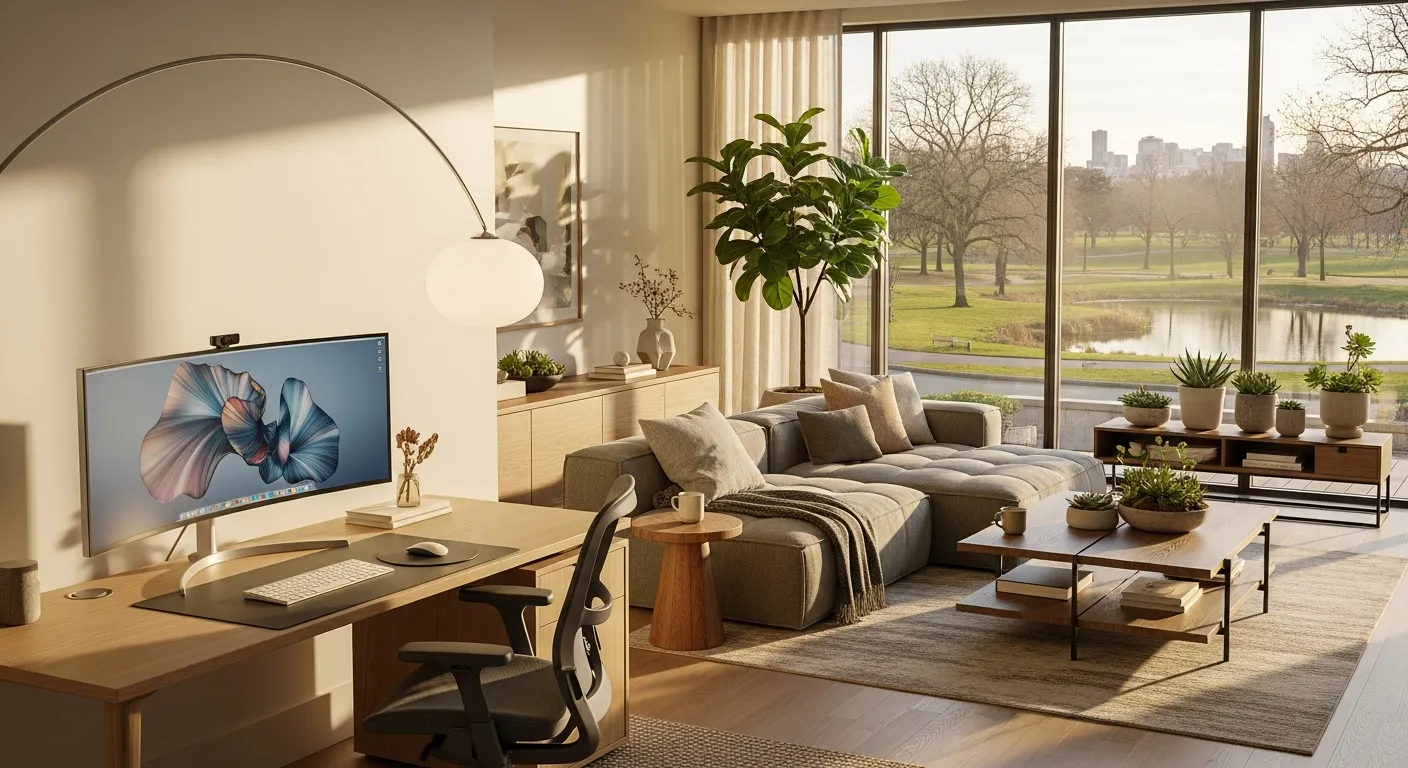
That’s a whole lot of people literally redesigning their daily environment around work-life balance. As a result, random desk placements are being discouraged. Homes have become more intentional and inclined towards work. Here’s what it looks like in real life:
- Corners being utilized as workspaces
- Rugs, shelves, and partitions becoming clear work boundaries
- Lighting setups designed for eye comfort rather than overhead glare
- Ergonomic seating being prioritized over those that only look aesthetic
- Hidden storage space to prevent work from spilling into personal space
The result is a home that doesn’t feel like an office exploded inside it. The environment remains flexible, so its inhabitants can switch roles as and when they please.
Professional Identity Is No Longer Tied to Workspace Design
Earlier, an individual’s professional identity and their workspace design were tightly linked. In simpler terms, one’s seriousness regarding their work was determined by how often and how long they stayed in the office.
Not to mention that the design also highlighted job hierarchy. For instance, senior professionals often had larger cabins or separate rooms for privacy. Essentially, there was a visual expectation tied to a corporate building address and a formal reception area. Today, although work still demands discipline, a traditional office environment is not the only answer.
Homes are being permitted to stay fully personal in design despite formal work taking place in them. Such a shift is particularly prevalent in cities where professionals operate in consulting, communications, and government-adjacent sectors. The roles involved here require a strong professional presence, even if work is largely done remotely.
In such cases, a virtual office becomes a practical solution for maintaining that external credibility without converting the home into a semi-corporate space. Professionals can separate their business identity from their living environment without compromising on accessibility.
At the same time, this clear demarcation has changed the way people think about privacy in a digital world. As The Farm Soho notes, professionals can keep their home address off the public records. This ensures that their living space remains private and their professional identity intact.
Let’s quickly dive into how the change in perception regarding professional identity has impacted interior design:
- Homes are designed for comfort rather than corporate presentation.
- Workspaces no longer need to hold cues of professionalism on video calls.
- Those conscious of their privacy can avoid exposing their residential details publicly.
- Home offices now prioritize peace and functionality over aesthetics.
- Design freedom has increased since the home is no longer an extension of one’s business or profession.
Human Well-Being Guides Interior Design Choices
For the longest time in the age of modernism, interior design choices oscillated between aesthetics and functionality. It appears that the repertoire of choices has expanded. It now includes flexibility and emotional balance to ensure the interiors can handle changing moods and extended screen time without generating mental fatigue.
Now, the important thing to remember is that the look of homes has certainly changed. However, there is more to it, as even how they support daily life is different now. Rooms are not expected to serve a single fixed purpose. Instead, they are designed to flex and adapt throughout the day.
As per a 2024 report, personalized and adaptable indoor environments are directly linked to improvements in productivity and well-being. Indoor environmental factors like lighting, air quality, acoustics, and spatial comfort show an unchanging impact on mental well-being.
The main idea we get from this is how interior design is not just visual, but also psychological. Listed below are the ways in which this change can be seen across residential structures:
- Flexible furniture setups that allow spaces to switch between work, rest, and social use
- Lighting that is strategic, like task lights for concentration or ambient lights for relaxation
- Low-stimulation layouts that reduce mental fatigue during long working hours
- Materials and textures chosen for calmness, not just their appearance
- Multipurpose areas, like a desk corner that can double up as a reading nook later
Thankfully, emotional comfort and productivity have been given the same pedestal now. This means a home’s interior design must support relaxation and rejuvenation over and above the demands of remote work.
Well, interior design didn’t reach this point by accident. In fact, that has been the case since time immemorial. Design evolves when the way people live in a particular time pushes it to. Remote work blurred the lines between office and home, and rigid design principles couldn’t keep up.
The good news is that applying the ideas this article has shared doesn’t require a full home makeover (although it’s your call!). Small, almost casual changes like the establishment of an intentional work zone or the incorporation of modular furniture will do the trick.
Most importantly, stop assuming that your home must choose a single identity. It does not need to be an office or a living space only. The best part is that it can be both, just not at the same time and in the same way. You get the drift, right?